Why Is My Skin Turning Green From Jewelry? (And How to Stop It)
Flaire & Co. Guides · Materials · 6 min read
It's the oldest jewelry trick in the book, and it usually isn't about you. That green ring around your finger is a reaction in the metal, and once you know what's behind it, it's easy to avoid.

The short answer
Green skin is almost always copper. When jewelry contains copper (or brass, which is a copper alloy) and that metal meets sweat or lotion, it oxidizes and leaves a green residue on your skin. The residue isn't harmful and washes off with soap and water. It does tell you the piece has a copper-containing metal at its surface.
01 / The chemistry
What's actually happening on your skin
The green color comes from a chemical reaction called oxidation between copper and things like water or chemicals. It's the same reaction that turns copper pennies and the Statue of Liberty green over time. In jewelry, the copper reacts with your sweat, lotion or other products on your skin, which is a recognized cause of greenish skin staining.
A lot of affordable jewelry is copper or brass (a copper and zinc alloy) with a thin layer of gold or silver on top. Copper is in fact the metal most often found in inexpensive jewelry, ahead of iron, zinc and nickel. While that top layer holds, the copper stays covered. Once it thins with wear, the copper gets to react. The gold itself isn't the issue, since gold-containing alloys release no detectable gold in sweat.
Green skin isn't a reaction your body is having. It's a reaction the metal is having.
Which pieces do it comes down to what they're made of. It's not that your skin is "bad" for jewelry. It's that some metals react with sweat and lotion, and others don't.
02 / Know the difference
Green skin is not an allergy
These two get mixed up all the time, so it's worth separating them.
| Green skin | Metal allergy | |
|---|---|---|
| What you see | A green or dark tint where the metal touched | Redness, itching, bumps, sometimes blisters |
| Cause | Copper oxidizing against sweat or lotion | Your immune system reacting to a metal, most often nickel |
| Does it wash off? | Yes, with soap and water | No. A rash needs the cause removed, so see a dermatologist if it persists |
| What to do | Change the metal | Change the metal, and see a dermatologist if it persists |
Nickel is the most common contact allergen in the general population, and pierced ears are a significant risk factor for it. Copper allergy, by contrast, is uncommon.
A piece can cause both at once, which is why people assume a green mark means they're allergic. If you get a rash, itching or swelling and not just a color change, stop wearing the piece and check in with a dermatologist.
03 / The metals
Which metals turn skin green (and which are built differently)
| Metal | Green skin? | Good to know |
|---|---|---|
| Copper, brass, bronze | Often | Copper-based, so this is the classic culprit |
| Traditional gold plating over brass or copper | Can, once the plating thins | Brass is a copper alloy, so copper can reach your skin once the gold wears |
| Sterling silver (925) | Possible | It's 92.5% silver and 7.5% copper. It's better known for dark tarnish |
| 316L stainless steel | Not expected | Not built on copper. It does contain some nickel, though published lab tests show very low nickel release |
| Titanium (ASTM F-136) | Not expected | Nickel isn't an alloying element. Titanium allergy is rare but reported |
One more thing: "hypoallergenic" on a tag doesn't tell you what's inside. It generally means a piece is made to be gentle on most people, but every skin is different, so it doesn't guarantee you won't react. Look for the actual metal named in the listing, like 316L stainless steel or titanium.


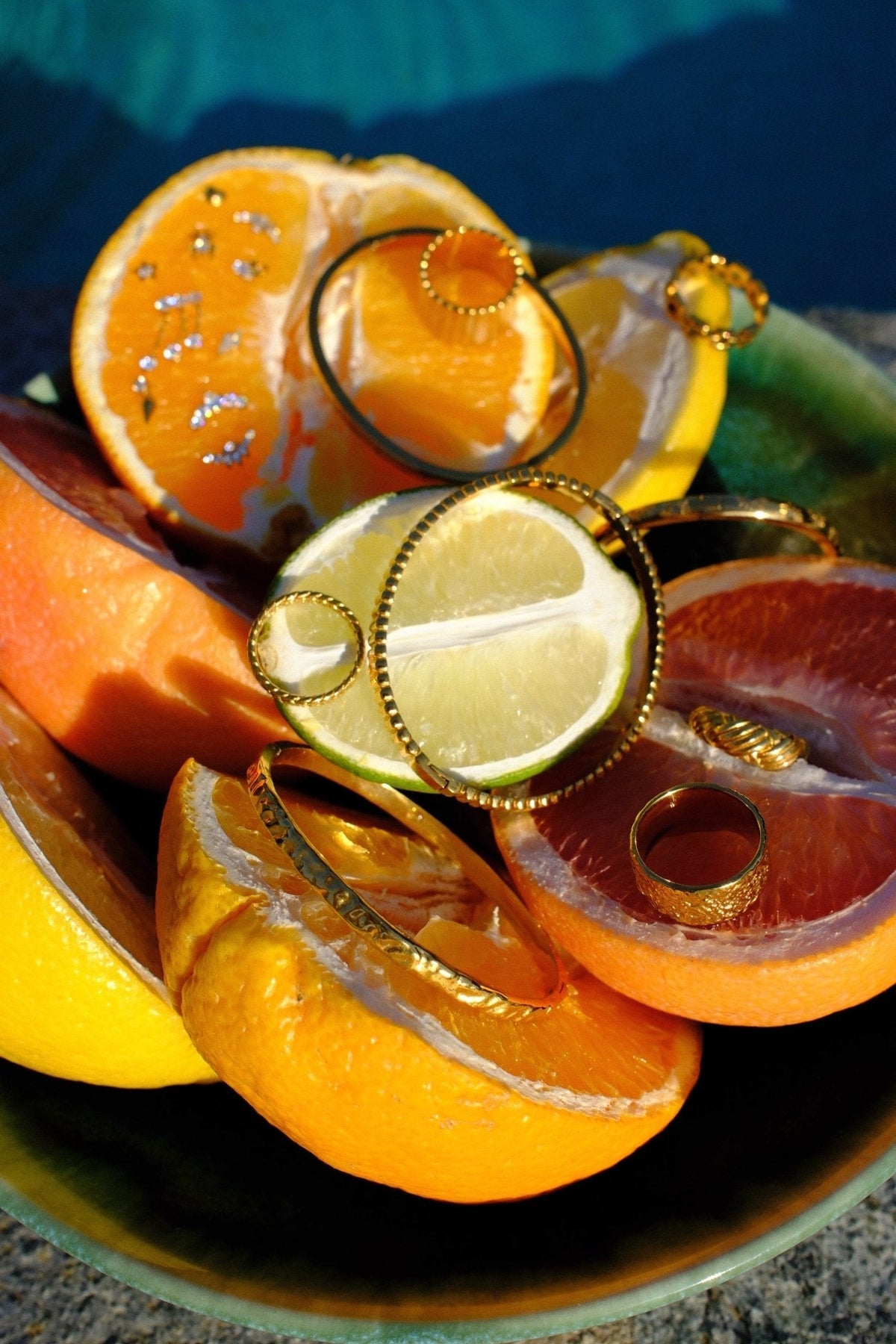
Hibiscus and Textured Stacker Cuff Bangles, stainless steel
04 / Already happened?
What to do if your skin has turned green
1. Wash it off. The residue comes off with soap and water.
2. Clean the piece. A gentle wash with mild soap, warm water and a soft cloth removes surface residue. Dry it fully afterwards.
3. Put jewelry on last. Sweat, lotion and other products on your skin are what the copper reacts with, so let them dry first.
4. Switch the metal. If a piece keeps turning you green, the metal is the cause.
05 / What we use instead
Jewelry not built on copper
We build our pieces on two materials, and neither one has a copper base. Our gold pieces are 316L stainless steel with a PVD gold finish applied in a vacuum, and our titanium pieces are ASTM F-136 titanium. You can read the details on our Our Materials page, and see the whole range in our Waterproof collection.
If you have a known nickel allergy, go straight to titanium. We break down the difference in Titanium vs Stainless Steel: Which Is Better for Sensitive Ears? and you can shop it all in our titanium jewelry collection.
Shop the edit


FAQ
Questions we get a lot
Is green skin from jewelry harmful?
No. The green residue isn't harmful and washes off with soap and water. If you also get itching, a rash or swelling, that's a separate issue, so stop wearing the piece and talk to a dermatologist.
Can gold plated jewelry turn your skin green?
It can, if the base metal underneath is copper or brass and the plating thins. Gold plating over stainless steel or titanium has no copper underneath to react.
Can stainless steel turn your skin green?
It's not expected to, because stainless steel isn't built on copper.
Can real silver turn your skin green?
Sterling silver is 92.5% silver and 7.5% copper, so it's possible, though it's better known for tarnishing dark. Silver-tone stainless steel isn't built on copper.
Does hypoallergenic jewelry turn your skin green?
It can. The word doesn't tell you the base metal, and every skin is different, so it doesn't guarantee you won't react. Look for the metal named, like 316L stainless steel or titanium.
How do you get the green off jewelry?
Wash it with mild soap and warm water, use a soft cloth or brush on the residue, and dry it fully. If the plating has worn through, cleaning won't bring it back, and the piece will keep doing it.
Sources
Nebraska Medicine, You asked, we answered: Why does some jewelry turn my skin green? (dermatology Q&A, 2021).
Ghosh SK, Bandyopadhyay D, The color of skin: green diseases of the skin, nails, and mucosa, Clinics in Dermatology, 2019 (abstract).
Hamann C et al., Jewellery: alloy composition and release of nickel, cobalt and lead assessed with the EU synthetic sweat method, Contact Dermatitis, 2015.
Lidén C et al., Metal release from gold-containing jewelry materials: no gold release detected, Contact Dermatitis, 1998.
Fage SW et al., Copper hypersensitivity, Contact Dermatitis, 2014.
Thyssen JP et al., The epidemiology of contact allergy in the general population: prevalence and main findings, Contact Dermatitis, 2007.
U.S. Geological Survey, Mineral Commodity Profiles: Silver (sterling composition).